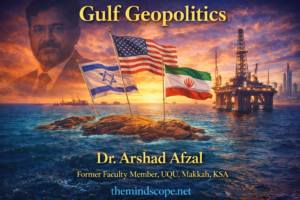
How the US–Israel–Iran Conflict Is Exposing the Colonial Security Architecture of the Gulf
The war now unfolding between the United States, Israel, and Iran is not merely another regional conflict. It is a historic geopolitical rupture. Beneath the missiles, air raids, and diplomatic drama lies a deeper structural transformation: the gradual unraveling of the colonial security order that has dominated the Gulf Cooperation Council (GCC) region for decades.
For more than half a century, the Gulf monarchies have lived under an American security umbrella. Massive military bases, fleets, intelligence networks, and air defense systems were built across Bahrain, Qatar, Kuwait, the United Arab Emirates, and Saudi Arabia. Officially, these installations were presented as guarantees of regional security and stability. In reality, the current war reveals something much more complex: these bases were never primarily about defending the Gulf states themselves. They were designed to project Western power across West Asia and protect the strategic interests of Israel and global energy routes.
Now that the region is engulfed in war, the contradictions of that system are becoming impossible to ignore.
The Architecture of Gulf Dependence
The United States maintains one of the largest overseas military networks in the world, and the Gulf region has long been one of its central pillars. According to defense analyses and Congressional reports, the US maintains multiple permanent and rotational military installations across the Middle East, including major bases in Qatar, Bahrain, Kuwait, and the UAE.
Al Udeid Air Base in Qatar, for example, serves as the forward headquarters of US Central Command and hosts thousands of American troops and aircraft.
Similarly, Bahrain hosts the headquarters of the US Navy’s Fifth Fleet, which patrols the Gulf, Red Sea, and Arabian Sea.
For decades, Gulf governments financed large parts of this infrastructure themselves. In the case of Al Udeid, Qatar paid billions to construct and expand the facility, effectively subsidizing the presence of a foreign military power on its own soil.
This arrangement was justified through a narrative of protection: the Gulf monarchies would receive security guarantees, while the United States would ensure stability in the global energy market.
But wars have a way of revealing truths that diplomacy hides.
The Moment the System Was Tested
When the United States and Israel launched strikes on Iran in 2026, the regional security architecture immediately faced its first genuine test in decades. Explosions were reported in multiple Iranian cities, and the conflict rapidly escalated into a broader regional confrontation.
Iran retaliated with missile and drone attacks targeting Israeli positions and American military facilities across the region, including installations in Bahrain, Qatar, Kuwait, and the United Arab Emirates.
In other words, the war exposed a stark reality:
the very bases that were supposed to guarantee Gulf security suddenly became magnets for retaliation.
From Iran’s perspective, these installations are not neutral defensive structures. They are forward operating platforms used to conduct military operations across West Asia. Analysts have long warned that any confrontation between Washington and Tehran would automatically place Gulf states at risk because of these bases.
And that is precisely what has happened.
The Colonial Security Paradigm
To understand the deeper meaning of this moment, one must look beyond current events and examine the historical structure that produced them.
After the Second World War, Western powers gradually replaced direct colonial rule with what political scientists call security dependency systems. Instead of governing territories directly, external powers maintained influence through military alliances, economic leverage, and strategic bases.
In the Gulf, this system replaced the British imperial presence that dominated the region until the early 1970s.
The formula was simple:
- Gulf monarchies would export oil to global markets.
- Western powers would guarantee regime security.
- Military bases would ensure strategic control of sea lanes and regional politics.
Over time, the arrangement became normalized. American warships docked regularly in Gulf ports, and US aircraft operated from airfields across the region.
But the current war has exposed the central paradox of this system.
The bases were never designed to defend the Gulf population from war.
They were designed to project war outward.
The Israel Factor
Another dimension of this geopolitical structure is the strategic relationship between the United States and Israel.
Israel has long been Washington’s closest military partner in the region. Military aid, intelligence cooperation, and technological collaboration have tied the two states together for decades.
In practice, this relationship means that the broader American military presence in West Asia often operates in alignment with Israeli strategic interests.
Critics argue that this alignment has drawn Gulf states into geopolitical rivalries that were never originally their own.
When the US and Israel launched coordinated operations against Iran in 2026, the regional consequences were immediate. The conflict expanded beyond the original battlefield and began to affect energy markets, air travel, and shipping lanes across the Gulf.
Oil prices surged, global markets reacted, and the entire region suddenly found itself at the center of a potential wider war.
For Gulf citizens, this moment raised a fundamental question:
Are these bases protecting us — or exposing us?
The War of Endurance
Iran’s strategy in the conflict appears to focus on endurance rather than immediate victory. Analysts note that Tehran is attempting to sustain pressure through missile strikes, energy disruptions, and asymmetric tactics designed to prolong the war and strain its adversaries.
From a geopolitical perspective, this strategy targets not only military forces but also the political cohesion of the coalition confronting Iran.
Every strike on a foreign military installation in the Gulf highlights the underlying contradiction of the region’s security model.
Each attack reinforces the perception that the Gulf states have become frontline territories in a war between larger powers.
The Emergence of a New Regional Consciousness
History shows that geopolitical shocks often trigger deeper political transformations.
The Suez Crisis of 1956 accelerated the decline of European colonial influence in the Middle East.
The Iranian Revolution of 1979 reshaped the ideological landscape of the region.
The current conflict may represent another such turning point.
As Gulf populations witness their territory becoming entangled in great-power conflicts, a new debate is likely to emerge about sovereignty, independence, and regional security.
Already, the war has forced regional governments to reconsider their diplomatic strategies.
Some Gulf states have called for de-escalation and negotiations, warning that prolonged conflict could devastate the region’s economies and infrastructure.
The stakes are enormous.
Toward a Post-Colonial Security Order?
If the war continues or escalates, the consequences could extend far beyond the battlefield.
Three major geopolitical shifts are possible:
1. Reconsideration of Foreign Bases
The presence of foreign military infrastructure may increasingly be viewed as a liability rather than a guarantee of security.
2. Regional Security Frameworks
States in West Asia may begin exploring security arrangements that rely more heavily on regional cooperation rather than external powers.
3. Strategic Autonomy
Energy-producing nations may seek greater independence in foreign policy, balancing relations with multiple global powers rather than relying exclusively on a single security patron.
These changes will not happen overnight.
But the process may already have begun.
The End of an Era
Empires rarely collapse suddenly. More often, they erode gradually as the structures that sustain them lose legitimacy.
The American security architecture in the Gulf has endured for decades because it appeared stable, profitable, and effective.
The war between the United States, Israel, and Iran has now placed that architecture under unprecedented strain.
Whether the conflict ends in weeks or months, one fact is becoming increasingly clear:
The geopolitical map of West Asia is being redrawn.
The Gulf states are no longer merely observers of great-power rivalry. They have become central actors in a historical transformation that may determine the future balance of power across the region.
And once a region begins to question the foundations of its security order, the old system rarely survives unchanged.
By Faraz Parvez
Professor Dr. (Retired) Arshad Afzal
Former Faculty Member, Umm Al-Qura University, Makkah, KSA
themindscope.net