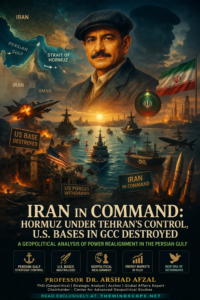
Iran’s Multi-Domain Deterrence Strategy and the End of Easy Wars
The contemporary Middle East is no longer governed by the assumptions that shaped Western military planning in the late twentieth century. The idea that overwhelming air power, rapid strikes, and regime-decapitation operations can reliably deliver political outcomes has eroded. Nowhere is this shift more visible than in Iran’s evolving deterrence doctrine. Iran has not built its strategy around conventional parity with the United States or Israel; instead, it has pursued a layered, multi-domain approach designed to deny adversaries the possibility of a clean, controllable conflict.
Deterrence today is not simply about possessing weapons; it is about shaping the adversary’s decision-making environment. Iran’s strategic posture aims precisely at that: raising uncertainty, multiplying costs, and blurring escalation thresholds to such an extent that initiating conflict becomes a strategic gamble rather than a calculated move.
From Conventional Inferiority to Asymmetric Mastery
Iran’s military planners understood early that matching Western air forces plane-for-plane or ship-for-ship was neither feasible nor necessary. Instead, they focused on exploiting geography, time, and political constraints. The Persian Gulf, the Strait of Hormuz, and surrounding littorals are not neutral spaces; they are narrow, crowded, and highly vulnerable to disruption. Iran’s doctrine turns these features into strategic assets.
Rather than relying on a single decisive weapon, Iran has invested in redundancy. Missiles, drones, fast-attack naval craft, cyber capabilities, electronic warfare, and proxy networks all function as overlapping layers. If one layer is degraded, others remain operational. This approach mirrors modern resilience theory: systems survive not by perfection, but by adaptability.
Missiles as Political Instruments
Iran’s missile arsenal is often discussed in numerical terms, but its real significance lies in its political function. Precision-guided missiles, with increasing range and survivability, allow Iran to hold adversary infrastructure at risk without crossing the nuclear threshold. Energy facilities, ports, airbases, command centers, and economic nodes are all within potential reach.
This capability does not require total destruction to be effective. Even temporary disruption of key services can have outsized political consequences in tightly interconnected economies. Insurance markets react, shipping reroutes, investor confidence wavers, and public pressure mounts. Deterrence here is psychological as much as physical.
Drone Warfare and the Economics of Attrition
Unmanned systems have transformed the cost calculus of conflict. Iran’s extensive use of drones—ranging from reconnaissance platforms to loitering munitions—creates an unfavorable exchange ratio for technologically superior adversaries. Interceptors and advanced air defenses are expensive; drones are comparatively cheap and replaceable.
This asymmetry matters in prolonged scenarios. A state that can impose sustained pressure at low cost gains leverage over one that must defend using high-value assets. The strategic lesson is clear: wars are not won by single spectacular strikes but by endurance.
Naval Asymmetry and the Strait of Hormuz
Conventional naval power emphasizes large platforms: carriers, destroyers, and submarines. Iran counters this with dispersion. Fast boats, naval mines, coastal missile batteries, and unmanned surface vessels create a complex threat environment in confined waters. Even the perception of risk can be enough to disrupt maritime traffic.
Crucially, Iran does not need to permanently close the Strait of Hormuz to achieve strategic effect. Temporary uncertainty is sufficient. Markets respond instantly; geopolitics reacts slowly. This time asymmetry favors the defender.
Cyber and Electronic Domains
Modern conflict unfolds as much in networks as on battlefields. Iran has invested steadily in cyber capabilities designed for disruption rather than spectacle. Financial systems, logistics platforms, communications infrastructure, and industrial controls all represent non-kinetic pressure points.
Electronic warfare adds another layer. Jamming, spoofing, and sensor degradation can reduce the effectiveness of precision weapons and surveillance systems, further complicating adversary planning. These tools operate below the threshold of declared war while still shaping outcomes.
Proxy Networks and Strategic Depth
Iran’s regional alliances are often described simplistically as proxies, but their real value lies in strategic depth. They expand the geographic scope of deterrence. Any conflict with Iran risks becoming multi-front, stretching resources and political tolerance.
Importantly, these networks are not designed for decisive conquest but for attrition and distraction. They force adversaries to defend multiple axes simultaneously, diluting focus and increasing uncertainty. In modern warfare, dispersion is power.
The Nuclear Question as Strategic Shadow
Iran’s nuclear program functions less as an immediate weapon and more as a strategic shadow. It shapes adversary calculations without requiring actual deployment. The ambiguity itself is a deterrent. The lesson of recent decades is unambiguous: states perceived as having latent nuclear capability are treated with greater caution than those without.
This reality does not require endorsement; it requires recognition. Deterrence works because decision-makers fear uncontrollable escalation, not because they seek it.
Why Regime Change No Longer Works
History has been unforgiving to theories of rapid regime change. Afghanistan, Iraq, Libya, and others demonstrate that destroying state structures does not produce stability or compliance. Iran’s size, population, institutional depth, and national identity make such outcomes even less plausible.
External attack tends to consolidate internal cohesion, not fracture it. Deterrence planners understand this. The real challenge is not defeating Iran militarily but managing the consequences of trying—and failing—to do so decisively.
A Multipolar Reality
Iran’s deterrence strategy operates within a changing global context. The world is no longer unipolar. Major powers have divergent interests, and global consensus on coercive action is harder to achieve. Economic interdependence further constrains escalation.
In such an environment, the cost of miscalculation rises sharply. Deterrence becomes less about dominance and more about restraint enforced by mutual vulnerability.
Conclusion: Deterrence as the New Stability
Iran’s multi-domain deterrence strategy reflects a broader transformation in global security. Power is no longer measured solely by platforms or budgets but by the ability to impose uncertainty, endure pressure, and deny adversaries clean victories.
This does not make conflict impossible—but it makes it profoundly unattractive. The age of easy wars is over. What remains is a strategic environment where restraint, negotiation, and realism are not signs of weakness but acknowledgments of a changed world.
Those who ignore this shift risk learning the lesson the hard way.
Dr. Arshad Afzal
Former Faculty Member, Umm Al-Qura University, Makkah, KSA
🌐 themindscope.net