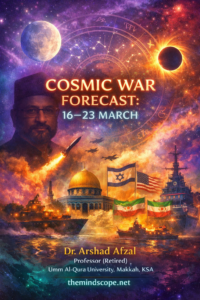
By Dr. Arshad Afzal
The MindScope – Geopolitics & World Affairs
I. INTRODUCTION: THE PROXY WAR FOR THE MIDDLE EAST
The recurring phenomenon of mass protests in Iran, particularly those characterized by sophisticated organization and amplified by international media, represents far more than a spontaneous eruption of domestic discontent. They are a critical front in a broader, undeclared geopolitical struggle—a proxy conflict waged by Western powers, led by the United States, and their regional allies, principally Israel, to contain and ultimately destabilize what they perceive as Iran’s existential threat to their strategic interests in the Middle East. This analysis will dissect the anatomy of these “engineered” protests, explore the deep-seated motivations driving external intervention, and assess their efficacy as a tool of geopolitical coercion. Ultimately, we will examine whether this strategy reveals more about the West’s fears of a declining hegemony than about the actual strength of the Iranian state.
II. IRAN’S REGIONAL HEGEMONY: THE ARCHITECTURE OF A PERCEIVED THREAT
To comprehend the scale of Western and Israeli alarm, one must first map the architecture of Iran’s influence, which extends far beyond its borders through a doctrine of “forward defense.”
This strategy is built on the foundation of the so-called “Axis of Resistance,” a network of state and non-state allies that forms a strategic crescent from the Persian Gulf to the Mediterranean. This includes the Assad regime in Syria, which provides Iran a land bridge to the Levant; Hezbollah in Lebanon, a heavily armed political-military entity with a vast rocket arsenal pointed at Israel; various Iraqi Shia militias integrated into the state’s security apparatus; the Houthi movement in Yemen, which has demonstrated the capability to strike deep into Saudi Arabia and disrupt international shipping; and Palestinian groups like Hamas and Palestinian Islamic Jihad in Gaza.
From a Western and Israeli perspective, this network constitutes a form of “asymmetric hegemony.” Iran projects power and deters adversaries not through matching conventional military might, but by cultivating capable proxies that can impose disproportionate costs. For Israel, this means being encircled by Iranian-aligned forces capable of launching rockets and drones, challenging its qualitative military edge and its freedom of action. For the United States and its Gulf allies, particularly Saudi Arabia and the UAE, it means facing a rival that can leverage regional grievances to undermine their security and influence, turning their own territories into potential battlefields.
The ultimate existential fear is an Iran empowered by a revived nuclear program. A nuclear-capable Iran, even if not weaponizing immediately, is seen as a game-changer that would permanently alter the regional balance of power, provide an umbrella for its proxies to act more boldly, and potentially trigger a regional nuclear arms race. This fear turns Iran’s internal stability into a matter of urgent strategic interest for its adversaries.
III. THE ANATOMY OF ENGINEERED INSTABILITY: TOOLS AND TACTICS
The term “engineered protests” does not imply that popular grievances in Iran are fabricated. Economic hardship, political repression, social restrictions, and environmental crises provide ample tinder for discontent, particularly among the youth and women. The engineering lies in the systematic external effort to amplify, weaponize, and direct this discontent toward regime-change objectives.
The primary tools in this arsenal are sophisticated information and cyber warfare. A vast ecosystem of Persian-language media outlets based abroad—funded by Western governments, Saudi Arabia, and Israeli-linked entities—operates 24/7 to magnify protests, circulate often-unverifiable atrocity narratives, and encourage civil disobedience. Hashtag campaigns are launched and boosted to create an illusion of overwhelming national consensus against the state. Cyber-attacks target Iranian government infrastructure, while circumvention tools like VPNs are promoted to help citizens bypass the state’s information controls, simultaneously enabling the flow of external propaganda.
Financial and organizational support forms the second pillar. The U.S. Congress has, for years, allocated hundreds of millions of dollars to programs officially dedicated to “promoting democracy” and “human rights” in Iran. Critics argue these funds ultimately flow to exile groups and non-governmental organizations that work to identify, train, and network dissident voices inside the country, providing organizational templates for protest and a pipeline for information out. Sanctions themselves, while framed as targeting the regime, are designed to cripple the economy, deepening public misery and, in theory, turning popular frustration against the government.
Diplomatic and symbolic amplification is the final tool. Western leaders and legislatures swiftly condemn the Iranian government’s response to protests, often using language that legitimizes the protests as revolutions and calls for international action. This serves to internationalize an internal issue, apply moral pressure, and signal to protestors that the world is watching—and, implicitly, supporting—their cause.
IV. STRATEGIC OBJECTIVES: REGIME CHANGE, CONTAINMENT, OR BARGAINING LEVERAGE?
The protests serve multiple, overlapping strategic objectives for Iran’s adversaries. The maximalist goal, particularly favored by certain factions in Washington, Tel Aviv, and Riyadh, is regime change. The hope is that sustained, nationwide unrest could fracture the Islamic Republic’s pillars of support—especially the Islamic Revolutionary Guard Corps (IRGC)—leading to its collapse or forcing a fundamental reordering of the state. This would dismantle the Axis of Resistance at its core, removing a generations-old strategic threat in one stroke.
A more pragmatic objective is containment and weakening. Even if the regime survives, a constant state of internal crisis saps its resources, attention, and legitimacy. A government perpetually firefighting at home is less capable of projecting power abroad. It is forced to divert security and economic resources inward, weakening its regional initiatives and its position in any future negotiations, be they on the nuclear file or regional détente.
Finally, protests are used as a form of coercive diplomacy and bargaining leverage. The message to Tehran from Western capitals is clear: your domestic instability is a vulnerability we can exacerbate. This is meant to pressure Iran into making concessions—on its nuclear program, its missile development, or its support for proxies—in exchange for a relaxation of sanctions or a cessation of support for opposition elements. It is a form of pressure aimed at the negotiating table.
V. THE IRANIAN STATE’S RESPONSE: RESILIENCE AND COUNTER-STRATEGY
The Islamic Republic has developed a formidable counter-strategy after four decades of surviving internal upheaval and external pressure. Its first line of defense is a sophisticated domestic security apparatus, led by the IRGC and Basij paramilitary force, which is trained and equipped for crowd control and intelligence operations to identify and neutralize protest networks.
Simultaneously, the state wages its own information war. It attributes protests to foreign “conspiracies” led by the U.S., Israel, and Saudi Arabia, framing domestic dissent as treasonous collaboration with the enemy. This nationalist narrative aims to discredit protesters and rally its base. It also aggressively jams foreign broadcasts and cracks down on internet access to sever the digital lifeline of the demonstrations.
Perhaps most critically, the regime leverages its regional foreign policy as a source of domestic legitimacy. It portrays itself as the lone defender of Muslim dignity against American imperialism and Zionist aggression. Victories by its Axis of Resistance allies, or advancements in its nuclear and missile programs, are touted as national achievements that affirm its revolutionary mission, attempting to offset domestic failures.
VI. GEOPOLITICAL IMPLICATIONS AND VERDICT
The long-term efficacy of using engineered protests as a geopolitical weapon remains highly questionable, and the strategy carries significant risks. Thus far, it has demonstrated a poor track record of achieving its maximalist goals. The Iranian state has repeatedly shown a grim capacity to suppress unrest, and external intervention often allows it to deflect blame for its own failures, thereby strengthening its narrative of resistance against foreign enemies.
The principal risk for the West and its allies is a dramatic escalation. A cornered Iranian regime, facing what it perceives as an existential internal threat orchestrated from abroad, may choose to lash out externally. This could take the form of accelerated nuclear brinkmanship, more aggressive proxy attacks on U.S. forces or Israeli territory, or terrorism against dissident figures abroad. Such actions could easily spiral into a direct military confrontation that no party ostensibly wants.
Furthermore, this strategy exposes a profound hypocrisy that undermines Western moral authority. The fervent support for protests in Iran stands in stark contrast to the silence or support offered to autocratic allies in the region who suppress their own citizens. This double standard is not lost on global observers, particularly in the Global South, and it fuels the very anti-Western sentiments that Iran exploits.
Final Verdict: The engineered protests in Iran are indeed a manifestation of the West’s and Israel’s profound perception of Iran as an existential threat. However, this strategy is less a demonstration of Western strength than a revelation of strategic frustration. It is an admission that conventional military options are too perilous, sanctions alone are insufficient, and diplomatic engagement has failed to curb Iran’s rise. By attempting to manipulate Iran’s internal dynamics, its adversaries are playing a dangerous and unpredictable game. They are betting on the fragility of the Islamic Republic, but in doing so, they may be underestimating its deep-rooted resilience and its capacity to retaliate in ways that could set the entire region aflame. The protests, therefore, are not a path to resolution, but a symptom of a deeper, more intractable conflict—one where all sides are seeking victory through the other’s collapse, a perilous formula for perpetual crisis.
Dr. Arshad Afzal
Former Faculty Member, Umm Al-Qura University, Makkah, KSA
The MindScope Network – themindscope.net
Disclaimer: This analysis is based on open-source geopolitical assessment and aims to provide a framework for understanding complex international events. It does not advocate for any particular policy outcome.